
.png)
EINDHOVEN UNIVERSITY
TESTING AN INFLATABLE ANTENNA IN SPACE
High altitude platform testing for TU Eindhoven research

MISSION SUCCESS
PROVEN DEPLOYMENT AT 30KM
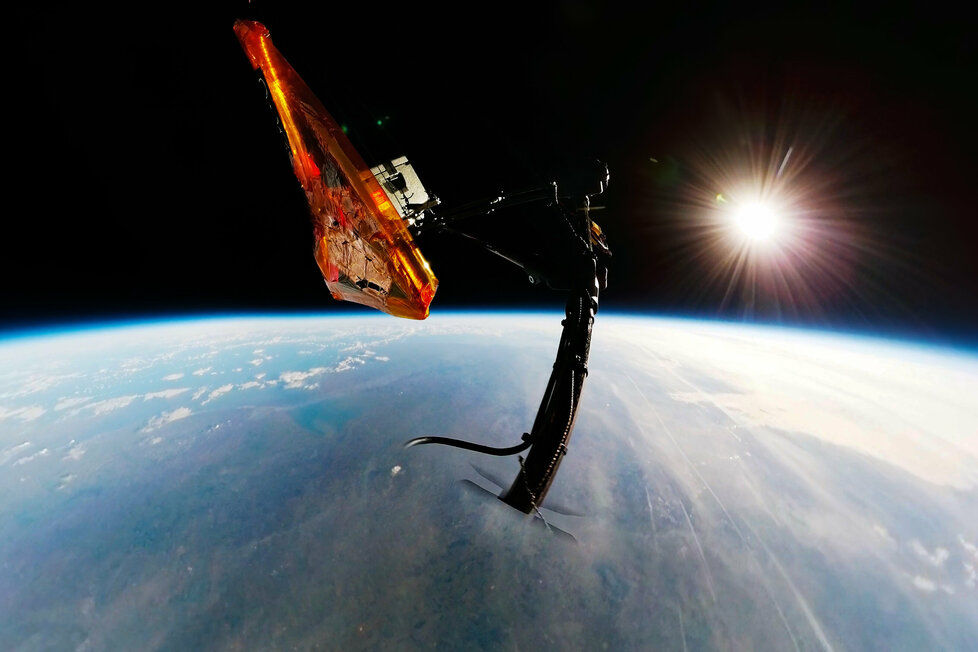
STUNNING IMAGERY
CAPTURED VIDEO AND SILLS
HEAPS OF DATA
COLLECTED TO AID RESEARCH
%20(2)%20(1).jpg)

Mission
Provide a high altitude platform for TU Eindhoven researchers to test a groundbreaking inflatable antenna deployment
Researchers at TU Eindhoven are developing an innovative inflatable antenna designed to study primordial signals originating from the earliest moments of the universe. The device is engineered to detect extraordinarily faint radio waves that have travelled for nearly 14 billion years since the Big Bang.
Before advancing the programme further, the team first needed to validate a critical milestone: proving that an inflatable antenna can reliably deploy in space conditions.

Execution
TU Eindhoven approached us with a clear objective: to demonstrate that an inflatable radio telescope antenna could deploy reliably in space-like conditions.
Our versatile High Altitude Platform System (HAPS) provides a proven near-space test environment capable of integrating complex aerospace hardware, including deployable structures, sensors, telemetry systems and small satellite technologies. For this mission, the system was configured to trigger antenna deployment once the platform surpassed 20 kilometres, the widely recognised threshold of Near Space.
Lifted by a hydrogen-filled high altitude balloon, the HAPS spacecraft ascended to over 30 kilometres, providing extended dwell time well above the 20 kilometre boundary. This sustained near-space exposure enabled a successful autonomous deployment of the inflatable antenna, captured in breathtaking high-resolution footage.
Beyond the headline deployment success, the flight delivered hours of environmental and systems data across the ascent, float and descent phases. This rich dataset is now feeding directly into TU Eindhoven’s iterative development cycle, accelerating the antenna’s progression towards operational readiness.